Sustainability

Sustainability at Banpu NEXT

At Banpu NEXT, we believe that business growth must go alongside creating sustainable value for society and the environment. We are committed to driving our business through a sustainability-focused approach, combining innovation, clean energy technology, and collaboration across all sectors. By delivering innovative energy solutions that elevate quality of life and build a better future for everyone.

Road to Net Zero

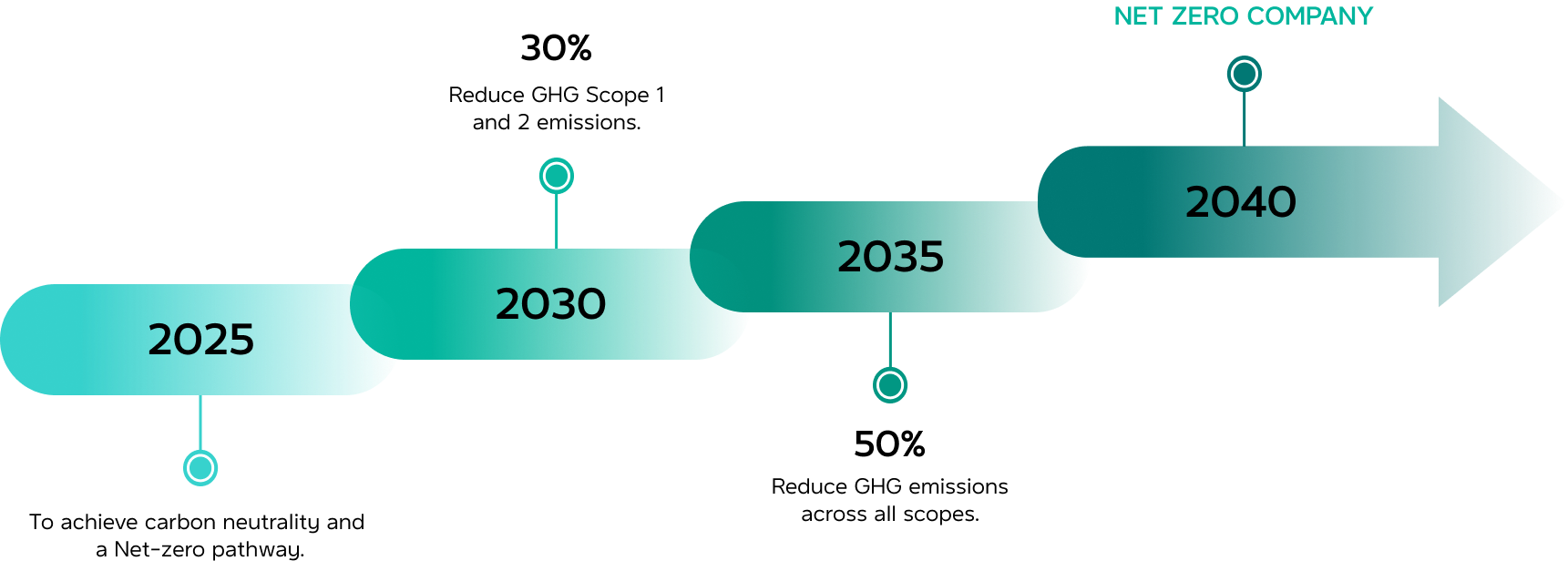
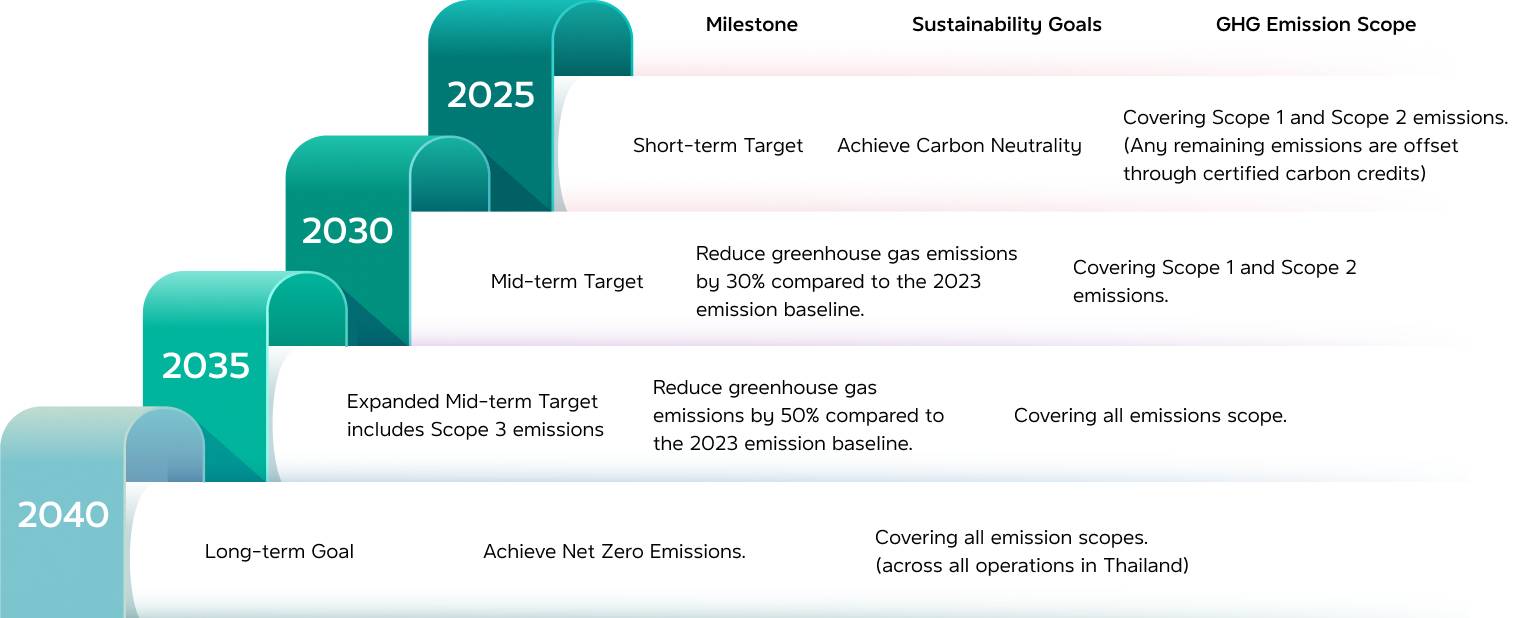
Banpu NEXT has set a target to achieve Net Zero Emissions by 2040. This commitment aims to enhance operational excellence, drive sustainable growth, and create long-term value for businesses, communities, and stakeholders. We support driving the transition to a low-carbon society, advancing Thailand’s Net Zero goals, and building a sustainable future for the world together.

GHG Reduction Target

The company has established a greenhouse gas reduction roadmap targeting an average emissions reduction of approximately 6% per year. The target is to reduce a total of 5,203 tonnes of carbon emissions from Scope 1 and Scope 2 sources by 2030. Scope 3 emissions calculations are currently underway as part of the company’s broader decarbonization strategy. Banpu NEXT plans to calculate and publicly disclose greenhouse gas emissions across all 3 scopes as required by the draft Climate Change Act.
* The company calculates greenhouse gas emissions using 2023 as the baseline. The target framework aligns with internationally recognized climate standards with the goal of limiting global temperature rise to below 1.5°C.

2030 GHG Reduction Target (Scope 1 & Scope 2)

5,203 tCO₂e

Currently, greenhouse gas emissions have been reduced by

3,240 tCO₂e

Equivalent to planting approximately

188,430 trees

Equivalent to saving approximately

223,227 liters of water

As of 2026, the company achieved a GHG reduction of 3,240 tonnes of carbon emissions, or 62.3% of the target.

4 STRATEGIC PATHWAYS
for GREENHOUSE GAS REDUCTION

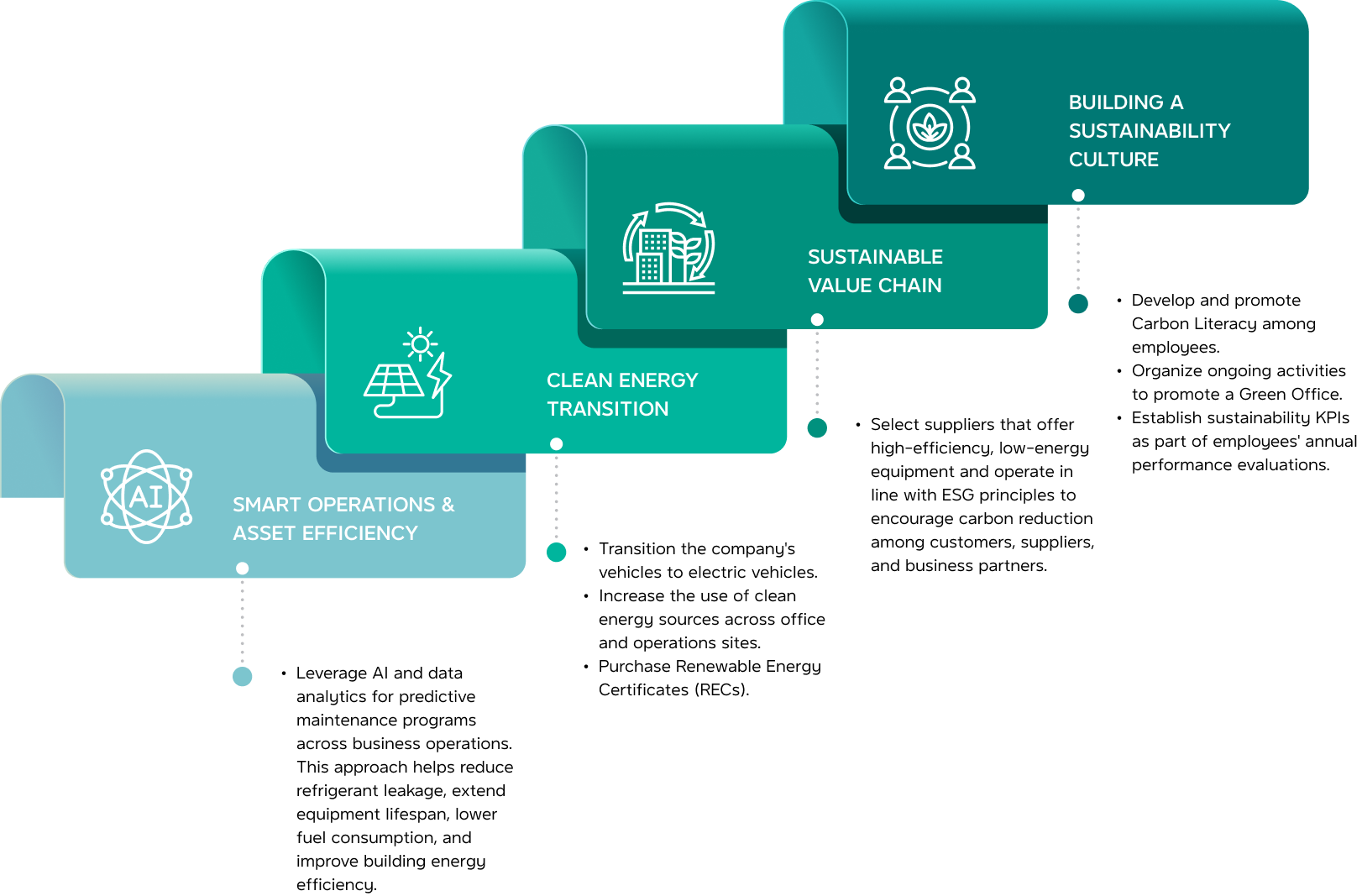
To achieve measurable greenhouse gas (GHG) reduction targets. Banpu NEXT has established strategic pathways covering all key business operations, as follows:

GreenHouse Gas Reduction
Pathway by Emission Scope

Scope 1 – Direct Emissions

Transition company vehicles to electric vehicles according to the following plan:

2027

30%

Replace of diesel vehicles with electric vehicles.

2030

60%

Replace of diesel vehicles with electric vehicles.

2035

100%

Achieve replacement of diesel vehicles with electric vehicles.

Scope 2 – Indirect Emissions from Energy

Increase the use of clean energy sources across office and operations sites.

Upgrade office equipment to energy-efficient electronics.
Reduce office electricity usage, such as installing automatic sensor-based lighting control systems.

Scope 3 – Other Indirect Emissions

Categories
GHG Reduction Action
Category 1
Purchased Goods & Services
• Establish a Sustainable Procurement Policy, incorporating ESG criteria as part of supplier evaluation and selection processes.
Category 4 and 9
Upstream & Downstream, Transportation & Distribution
• Set selection criteria for transportation service providers that utilize electric vehicles or biofuels and track distance and shipment volume data to calculate greenhouse gas emissions.
Category 5
Waste Generated in Operations
• Promote a Zero Waste to Landfill policy, targeting zero landfill waste by 2030 through the 3R approach: Reduce, Reuse, and Recycle effectively.
Category 6
Business Travel
• Promote online meetings to reduce international travel.
• Promote rail transportation as an alternative to air travel for short distances.
• Choose airlines that use Sustainable Aviation Fuel (SAF).
Category 7
Employee Commuting
• Promote a Hybrid Work policy.
• Promote Carpool policy.
• Encourage employees to switch to electric vehicles and use public transportation.
• Provide EV charging infrastructure at company facilities to support employee EV adoption.
Category 11
Use of Sold Products 
• Develop solutions that help customers reduce greenhouse gas emissions such as Solar Power Purchase Agreement (PPA) solutions, Energy Storage Systems (ESS), EV Fleet Management solutions, and Energy Efficiency solutions.
Category 15
Investments
• Select investments based on ESG criteria as part of the investment evaluation process.
• Report greenhouse gas emissions from investments and financing (Financed Emissions) in accordance with Partnership for Carbon Accounting Financials (PCAF) standards
•  Realign investment portfolios toward sustainability-focused and low-carbon assets.

Sustainability at Banpu

Banpu Group’s Sustainability Journey

Our sustainability journey began with a simple yet deep commitment: To create a positive impact and better living for all. We pledged to integrate sustainable practices into every aspect of our operations, products, and services, through viable strategy, innovation and partnerships.

Rewards and Certificates  

The international REC Standard (I-REC)

The international REC Standard (I-REC)

Recognized Climate Action Leading Organization

Carbon Neutral 2025

Carbon Footprint for Organization (CFO) 2026

Carbon Footprint for Organization (CFO) 2025

The international REC Standard (I-REC)

Carbon Footprint for Organization (CFO) 2026

Sustainability Memberships

Carbon Markets Club

Carbon Neutral Network

The Federation of Thai Industries

Banpu Group CSR 

Banpu carries out purpose-driven corporate social responsibility (CSR) activities to address societal needs and reflect the Company’s core value, which is ‘people.’ Our corporate-level CSR initiatives focus on developing human potential under the concept of “Embracing Potential, Energizing People.” This framework aims to empower individuals to maximize their potential so that they can create positive impact for themselves, their communities, and society at large. It also promotes equality, reduces disparities, and expands opportunities for a better future.